Carnegie Mellon College of Engineering
Coordinates: 40°26′32″N 79°56′47.1″W / 40.44222°N 79.946417°W / 40.44222; -79.946417
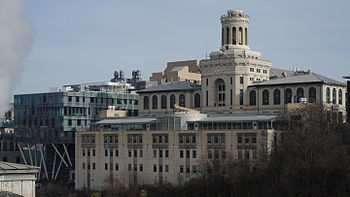 | |
| Type | Private Engineering School |
|---|---|
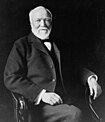
| Established | 1905 by Andrew Carnegie |
| Dean | James H. Garrett, Jr., P.E. |
| Undergraduates | 1,783 |
| Postgraduates | 1,383 |
Doctoral students | 703 |
| Address | 5000 Forbes Avenue , Pittsburgh , PA , United States |
| Campus | Urban |
| Website | engineering.cmu.edu |
The Carnegie Mellon University College of Engineering is the academic unit that manages engineering research and education at Carnegie Mellon. The College can trace its origins from Andrew Carnegie's founding of the Carnegie Technical Schools. Today, The College of Engineering has seven departments of study and is ranked 5th nationally.[1]
Contents
1 History
2 About the College of Engineering
3 Academics
4 Research
5 References
6 External links
History
By 1905, the massive buildings of the Carnegie Technical Schools were being constructed in a field east of the University of Pittsburgh. The first students of the School of Science and Technology began classes in unfinished buildings, still surrounded by new construction. The school initially offered two- and three-year programs to train the children of Pittsburgh's working class. After the merger between Carnegie Tech and the Mellon Institute of Industrial Research, the newly formed Carnegie Mellon University's College of Engineering and Science was divided into the Carnegie Institute of Technology (engineering) and the Mellon College of Science. Subsequently, the Carnegie Institute of Technology was re-branded as the College of Engineering.
The Carnegie Mellon College of Engineering has led the way in many engineering fields and trends. In 1971, with the help from the Heinz College, the College established one of the first departments in Engineering and Public Policy to educate engineers in social and policy issues while performing research in science and technology policy. In 1989, the College established the nation's first institute devoted to information networking, the Information Networking Institute.[2]
About the College of Engineering
Enrollment for or the 2017-2018 academic year was 1,783 full-time undergraduate, 1,383 master's, and 703 doctoral students.[3] The college employs 207 faculty members whose research is recognized and supported by such sources as the National Science Foundation, the National Institutes of Health, Defense Advanced Research Projects Agency, and the Environmental Protection Agency.[4] As part of Carnegie Mellon University, the College of Engineering works to carry out the university's mission of “changing the needs of society by building on its traditions of innovation, problem-solving and interdisciplinarity”.[5] Students in the College of Engineering have the advantage of working with experts in their own field of study, as well as with students and faculty across the other engineering departments and academic colleges. Because of the college's small size and focus on interdisciplinary collaboration, students graduate with a high-quality education that extends far beyond their expert technical knowledge, ensuring they have the problem-solving skills needed to be successful in a diverse collection of individual careers.[6] The College's Office of the Dean is housed in Scaife Hall, and the college's primary facilities include Hamerschlag Hall, Roberts Engineering Hall, Doherty Hall, and Scott Hall, in addition to Scaife.
Academics
Carnegie Mellon's College of Engineering offers undergraduate and graduate degrees in seven academic departments.
- Department of Biomedical Engineering
- Department of Chemical Engineering
- Department of Civil and Environmental Engineering
- Department of Electrical and Computer Engineering
- Department of Engineering and Public Policy
- Department of Materials Science and Engineering
- Department of Mechanical Engineering
There are also several institutes and centers:
- Information Networking Institute
- Engineering Research Accelerator
- Scott Institute for Energy Innovation
- CyLab
CMU offers five unique interdisciplinary degrees.
- Energy Science, Technology, and Policy
- Engineering and Technology Innovation Management
- Colloids, Polymers, and Surfaces
- Integrated Innovation Institute
- MBA and Engineering Integrated 5-year Program
Research
The Carnegie Mellon College of Engineering has an international reputation in research and innovation and is affiliated with several research centers.
References
^ US News Engineer Ranking
^ College of Engineering Interactive Timeline Archived August 20, 2010, at the Wayback Machine
^ Enrollment Facts 2017 by College
^ About the College of Engineering: distinguishing characteristics Archived July 15, 2010, at the Wayback Machine
^ College of Engineering vision and mission
^ College of Engineering educational objectives
Fenton, Edwin (2000). Carnegie Mellon 1900-2000: A Centennial History. Pittsburgh: Carnegie Mellon University Press. ISBN 0-88748-323-2..mw-parser-output cite.citation{font-style:inherit}.mw-parser-output .citation q{quotes:"""""""'""'"}.mw-parser-output .citation .cs1-lock-free a{background:url("//upload.wikimedia.org/wikipedia/commons/thumb/6/65/Lock-green.svg/9px-Lock-green.svg.png")no-repeat;background-position:right .1em center}.mw-parser-output .citation .cs1-lock-limited a,.mw-parser-output .citation .cs1-lock-registration a{background:url("//upload.wikimedia.org/wikipedia/commons/thumb/d/d6/Lock-gray-alt-2.svg/9px-Lock-gray-alt-2.svg.png")no-repeat;background-position:right .1em center}.mw-parser-output .citation .cs1-lock-subscription a{background:url("//upload.wikimedia.org/wikipedia/commons/thumb/a/aa/Lock-red-alt-2.svg/9px-Lock-red-alt-2.svg.png")no-repeat;background-position:right .1em center}.mw-parser-output .cs1-subscription,.mw-parser-output .cs1-registration{color:#555}.mw-parser-output .cs1-subscription span,.mw-parser-output .cs1-registration span{border-bottom:1px dotted;cursor:help}.mw-parser-output .cs1-ws-icon a{background:url("//upload.wikimedia.org/wikipedia/commons/thumb/4/4c/Wikisource-logo.svg/12px-Wikisource-logo.svg.png")no-repeat;background-position:right .1em center}.mw-parser-output code.cs1-code{color:inherit;background:inherit;border:inherit;padding:inherit}.mw-parser-output .cs1-hidden-error{display:none;font-size:100%}.mw-parser-output .cs1-visible-error{font-size:100%}.mw-parser-output .cs1-maint{display:none;color:#33aa33;margin-left:0.3em}.mw-parser-output .cs1-subscription,.mw-parser-output .cs1-registration,.mw-parser-output .cs1-format{font-size:95%}.mw-parser-output .cs1-kern-left,.mw-parser-output .cs1-kern-wl-left{padding-left:0.2em}.mw-parser-output .cs1-kern-right,.mw-parser-output .cs1-kern-wl-right{padding-right:0.2em}

External links
- Carnegie Mellon University College of Engineering official website
- Carnegie Mellon Nanofabrication Facility
Carnegie Mellon University | ||
|---|---|---|
| Academics |
|  |
| Branch campuses |
| |
| Student life |
| |
| Research |
| |
| People |
| |
| Projects and legacies |
| |


